
Compare Medicare Supplement Plans Side by Side
Medicare Supplement policies, also known as Medigap policies, are sold by private insurance companies and are designed to help pay some of the out-of-pocket costs that Original Medicare doesn't cover, such as certain copayments, coinsurance, and deductibles.
In most states, Medigap policies are standardized and identified by letters. Policies with the same plan letter provide the same standardized basic benefits regardless of which insurance company sells the policy. For example, the basic medical benefits provided by one company's Plan G are the same as those provided by another company's Plan G. Premiums and other features can vary by insurance company.
As licensed insurance agents, we can help you understand the differences between Medigap plans and compare available options so you can determine which coverage best fits your needs.
In Massachusetts, Minnesota, and Wisconsin, Medigap policies are standardized differently.
What should I know about Medigap plans?
Each insurance company decides which Medigap policies it wants to sell, subject to federal and state requirements. Not every plan is available from every insurance company or in every state.
Insurance companies that sell Medigap policies:
- Must offer Medigap Plan A.
- If they offer additional Medigap policies, they must also offer Plan C or Plan F to people who were eligible for Medicare before January 1, 2020, and Plan D or Plan G to people who became newly eligible for Medicare on or after January 1, 2020.
- May offer other standardized Medigap plans depending on the insurer and state.
Medigap policies generally help pay your share of costs for services covered by Original Medicare. The Medigap policy pays according to the benefits included in the specific plan you choose.
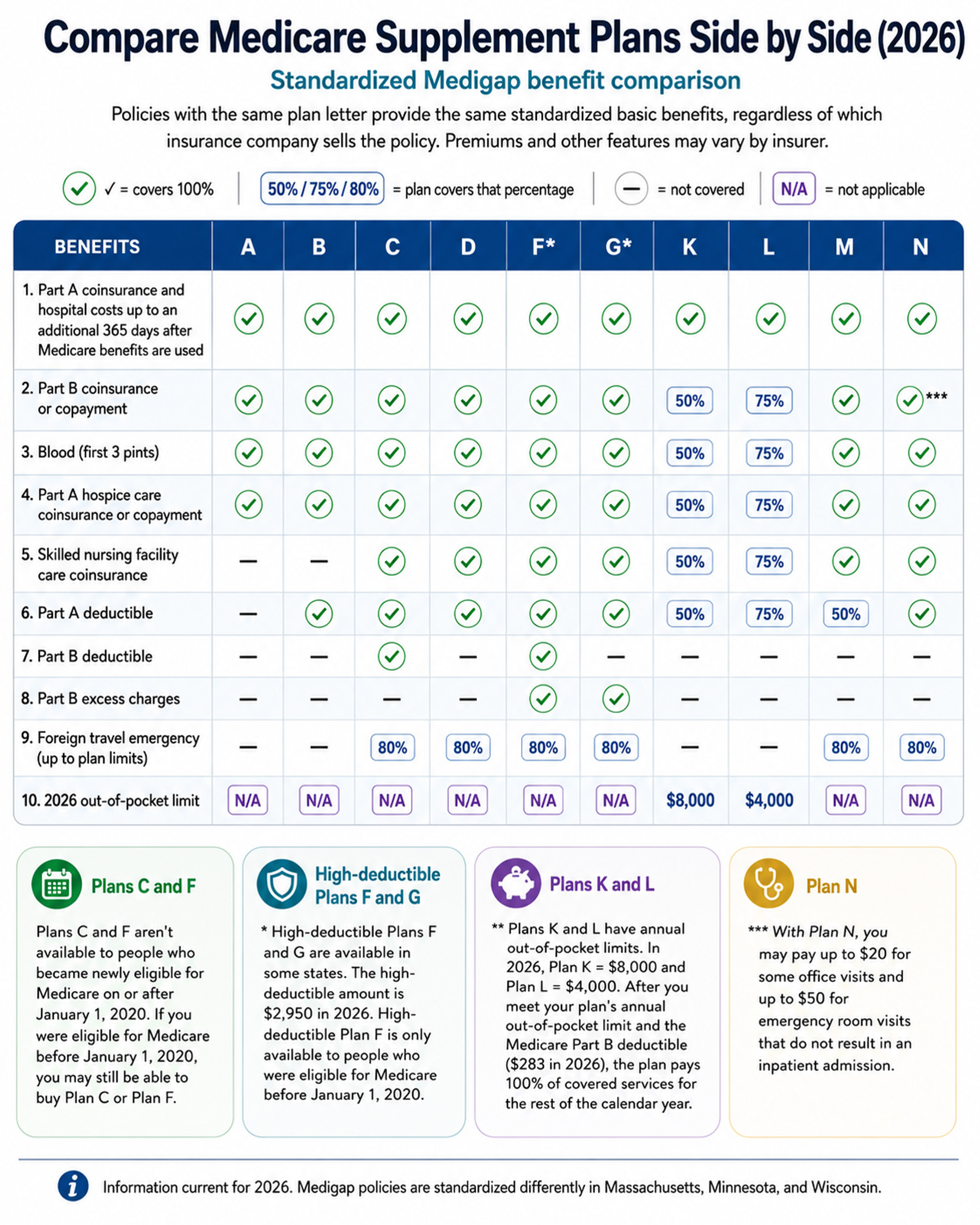
Foreign travel emergency coverage
Plans C, D, F, G, M, and N provide limited foreign travel emergency coverage. These plans generally pay 80% of qualifying emergency medical costs outside the United States, subject to the plan's requirements and limits.
Foreign travel emergency benefits generally include a $250 annual deductible, apply to qualifying emergencies that begin during the first 60 days of a trip, and have a $50,000 lifetime limit.
When is the best time to buy a Medigap policy?
The best time to purchase a Medigap policy is generally during your Medigap Open Enrollment Period.
This is a one-time, six-month enrollment period that begins the first month you are both:
- 65 or older, and
- Enrolled in Medicare Part B.
During your Medigap Open Enrollment Period, you can generally purchase any Medigap policy sold in your state without being denied coverage or charged more because of pre-existing health conditions.
After this enrollment period ends, your options may be more limited. Depending on your circumstances and state law, an insurance company may use medical underwriting, charge you more, or deny your application. Certain situations provide guaranteed issue rights, and some states provide additional Medigap enrollment protections.
Call us to help you understand your Medicare Supplement options.
Information current for 2026 and based on information from Medicare.gov and the Centers for Medicare & Medicaid Services.
By contacting the phone number on this website you will be directed to a licensed insurance agent. Not affiliated with or endorsed by the Government or Federal Medicare Program.